
惊天解密
China’s deep-processed agri-goods fuel higher-value trade growth_我的网站

一 |
Chinese plush toys, new-energy vehicles and robots often grab global headlines. Beyond the spotlight, however, many unassuming Chinese exports are quietly making great gains in markets around the world.
Recently, 14,040 specific pathogen free (SPF) eggs, also known as "diamond eggs" and prized as a critical raw material for vaccine research, took off from Beijing Daxing International Airport and landed in Riyadh, Saudi Arabia.
In the first half of 2026 alone, exports of Beijing-produced SPF eggs topped 400,000 units, soaring 254 percent year-on-year. Their export value exceeded 3.8 million yuan ($563,364), up 166 percent year-on-year. Both figures already surpassed the full-year total for 2025, according to statistics from the Beijing customs.
"Diamond eggs" are not alone. Many processed farm goods from various regions across China, ranging from loofahs to new corn-based synthetic fibers to "icy persimmons," are reaching consumers in many countries and regions around the world, with rising export volumes.
Behind the headline numbers lies a quiet change: China is no longer content to ship out raw apples, live fish, or unprocessed grain. It is climbing the value chain - turning farmyard staples into high-value, shelf-ready products for markets around the world, Zhu Qiucheng, CEO of Ningbo New Oriental Electric Industrial Development, told the Global Times.
New e-commerce stars
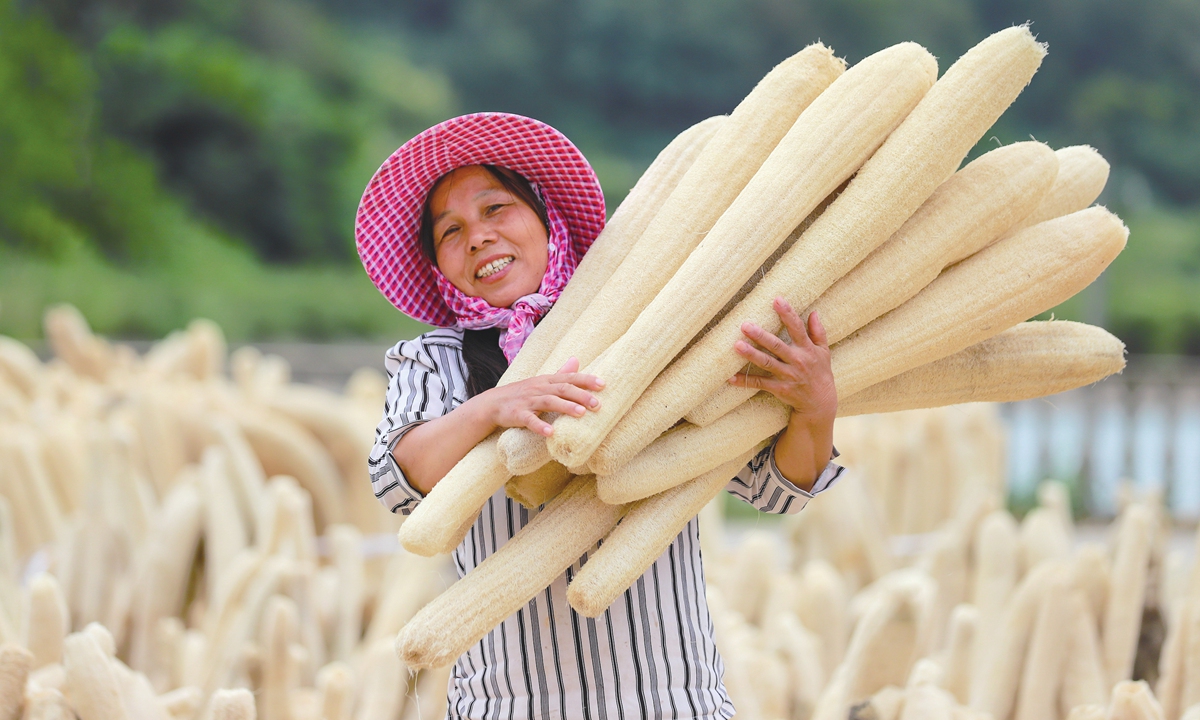
In Shangcheng County, Central China's Henan Province, the loofahs once lived a quiet life next to the stove - serving as kitchen scrubbers. Today they are a cross-border e-commerce star.
"We have built processing factories, design teams and unified procurement systems that link agricultural cooperatives and farmers across dozens of villages, turning sponge gourds - a traditional side crop - into a scalable, export-oriented industry," a sales manager at Yuangeng Longshang, a local producer and exporter of sponge gourd-related products, told the Global Times.
Processors in Shangcheng have developed more than 60 loofah product lines - ranging from bath sponges and kitchen scrubbers to pet toys and cultural-creative items - and sell them via Amazon, AliExpress, Temu and other platforms to more than 50 countries and regions, according to media reports.
In the first half of 2026, Shangcheng's e-commerce transaction volume of loofah-made products exceeded 30 million yuan, up 35 percent year-on-year. At present, the annual comprehensive output value of the loofah industry in the county has exceeded 100 million yuan.
Apart from sponge gourds, corn has also found a new way to become cloth.
"Unlike traditional synthetic fibers made from petroleum, the core ingredient of our flagship Sorona-based series comes from corn," Hong Boqi, general manager of Chuanyue New Material Co, a domestic cloth supplier, told the Global Times.
The process of making Sorona starts by fermenting corn sugars to extract Bio-PDO (a bio-based chemical building block, essentially a plant-derived version of the molecule used in certain plastics). This is then polymerized and spun into yarn and finished fabric.
The company has independently developed more than 300 Sorona fabric varieties, said Hong.
The firm is also exploring seaweed. Working with a domestic biotech partner, it created an "ice algae mud" functional fabric. Natural seaweed is finely ground and combined with a composite powder made from nephrite, then processed through a specialized spinning method. The finished textile is designed for recycling, reinforcing its green credentials.
Behind these advances lie years of patient research and development. Chuanyue invests about 4 million yuan annually in early-stage material development, covering the full journey from lab innovation to finished fabric, said Hong.
Innovative ways
Apart from being processed into industrial products, Chinese fresh fruits and vegetables are also processed in innovative ways to reach global consumers.
For example, Hainan Nicepal Industry Co is not simply selling fresh fruit. Instead, it uses advanced spray-drying technology to turn fresh fruits into fruit powders, concentrated juices, and not-from-concentrate (NFC) purees.
Pan Fengying, deputy general manager of the Hainan-based company, said that the company's output value reached 600 million yuan last year, and this year's target is 1.2 to 1.5 billion yuan, according to local media.
And in Yi County, North China's Hebei Province, fresh fruit that once spoiled quickly or fetched rock-bottom seasonal prices is now processed into "icy persimmons," which made exports easier.
In April 2026, the first batch of 15,000 persimmons was sent to Toronto, Canada. In the first half of this year, the sales volume of the ice-ripened persimmons in the county increased eightfold compared to the previous year; the annual production is expected to be 20 times that of last year, local authorities said.
Through controlled processes of de-astringency, sugaring and rapid freezing, the fruit develops a creamy, ice-cream-like texture while retaining its natural sweetness. Local authorities built a shared industrial park complete with standardized workshops, fully automatic production lines and large-scale intelligent cold storage, allowing micro- and small-sized firms to "move in without having to prepare for everything."
The China Agricultural Sector Development Report 2026, released in June, projected a pivot toward higher-value agricultural exports from 2026 to 2030. Categories such as processed fruits and nuts, frozen fruits, fish fillets and frozen vegetables are flagged for strong growth potential.
The message is clear: volume still matters, but value and differentiation matter more.
How did the "sudden" upgrade of the agricultural sector happen? Analysts pointed to two major reasons: pursuit of high-quality development and resilient supply chains.
China has emphasized high-quality development, guiding enterprises to focus more on quality over quantity. This has led to deep processing, brand building and new quality productive forces in the agriculture sector, said Zhu.
Zhu also noted that the speed and completeness of China's resilient supply chains are powering the transformation. Every link - from raw materials to finished goods, including processing, packaging, and logistics - is tightly connected.
。 今年以来,市司法局作为统筹推进法治建设的主责机关,在普法与依法治理工作中持续用力、奋发前行,抚顺市公民法治素养得到显著提升。

二 | 如今,我市燃起了全民尊法、学法、守法、用法的新热潮,展现出法治建设的新风貌。 市司法局以“头雁效应”引领普法宣传工作,强化普法责任制落实,明确各级机关普法责任分工。通过开展抚顺市国家机关“谁执法谁普法”2024年度履职报告评议会,让普法工作更具实效性。党员干部群众学法用法制度不断深化,学法清单内容与时俱进,推动各行业学法用法常态化,普法工作在管理服务中实现深度融合,推动宪法精神和法治思想深入人心。 抚顺市司法局普法与依法治理科科长崔龙说:“市司法局以多元化创新工作为推手,全力推动媒体融合普法持续发力,不断优化《律师讲法》《普法小讲堂》等传统普法平台,新开辟的《抚小司说法》等原创短视频普法内容不断推陈出新,以更生动、更贴近群众的方式传播法律知识,形成品牌化普法宣传效应。

三 | ” 近年来,全市法治文化阵地建设稳步推进,新屯法润万家主题广场等成为市民学法休闲的好去处,古田社区广场、南杂木广场将阵地建设向最基层延伸,营造出浓厚的法治氛围。依托 “三缘”“三情”优势,持续加强“法律明白人”培育,组织各类能力培训,提升其法治素养与业务水平。目前全市有4300余名“法律明白人”活跃在基层治理一线,成为法治宣传与矛盾纠纷化解的重要力量,为法治抚顺建设提供坚实保障。 抚顺市司法局普法与依法治理科科长崔龙说:“年终岁末,全市普法与依法治理工作在市法治建设委员会的坚强领导下、在市司法局党组的直接带领下,将以更加饱满的热情,更加昂扬的斗志,驰而不息投身全面振兴新突破的新征程,为建设更高水平的平安抚顺、法治抚顺贡献力量。

四 | ” 责任编辑:李丹。

五 |
Current article:http://sddif.chongtunkuaitaogacuiliamanzu.cfd/news/20260826_37046.html
Published on:22:32:11
栏目相关
- 伊犁四季旅行全攻略:从塞外江南到草原花海,详解行程交通住宿美食与特色体验建议指南
- 台风“沙德尔”登陆地点最新预测:即将进入24小时警戒线,预计于27日夜间至28日上午在浙江象山到福建福清一带登陆(12-14级)
- U.S. COVID-19 Hospitalizations Increase for 6th Straight Week
- “保交楼”专项借款或率先落地郑州 对95个问题楼盘进行审计_项目_建业地产
- 拉科布回应库里续约:尚未谈判 但完全不担心
- 科学家开发光激活的“智能塑料” 可用于柔性电子产品和机器人
- 奋进强国路 阔步新征程丨金“药”匙开启“致富密码”
- 三星电子、SK海力士计划下半年增加对英伟达8层HBM4内存供应量
- 方腾律师事务所,收钱以后,不尽心办理案件,敷衍。
- 普京丢掉奇怪方案,大量炸弹落向基辅,乌军抓壮丁,百姓开始反抗!,千羽解读,原创 普京丢掉奇怪方案,大量炸弹落向基辅,乌军抓壮丁,百姓开始反抗!
- 版本间隔 4 周 → 2 周:微软加速 WebView2 Runtime 更迭,和 Edge 浏览器同步更新
- 中报关注度持续升温,机构建议配置三条业绩主线
热门排行
- 《天堂》开发商二次元新作!《阿索拉:星之祈愿》开启测试玩家招募
- Kremlin: Delivery of Turbine From Canada Will Allow to Boost Gas Supplies Via Nord Stream
- 00后演员自曝:我和王星收到的是同一份剧组邀约!落地泰国后侥幸逃脱……曾有群演被骗,经历太恐怖
- 本地大宗订单诈骗卷土重来 427起报案商家损失至少680万
- Arun Matheswaran Wraps Schedule of DC With Lokesh Kanagaraj and Wamiqa Gabbi
- 这个乡镇“筹资”有方,奖励一位90后教师价值200万元住房_尤凡_教育
- Japanese PM sends ritual offering to notorious Yasukuni Shrine
- More than 40 People Found Dead in Tractor Trailer in Possible Human Smuggling Case
- 哈利伯顿不满复出首战安排:客场无直播令人震惊
- 上海黄浦:到2030年,预计累计新增高能级首店100家左右
- 受广东强降雨影响多趟列车晚点停运 全额退票如何办理?
- 总理怀唐伊讲话部分“复制”去年演讲稿 他回应“是故意的”