
'Freest' China: Pelosi Commends Beijing After Contentious Taiwan Visit in Apparent Gaffe NBA年终大战赛程出炉:老詹率76人对决湖人 马刺尼克斯重演总决赛
妒海
서울시 "용산공원 주택공급 철회시 그린벨트 일부 해제 검토"_我的网站

一 |

China reported 522,000 newly confirmed COVID-19 cases in July, including 487 severe cases and one related death with cases showing a fluctuating upward trend, China's national disease control authority said.
The current uptick in infections represents another regular cyclical wave, with its severity comparable to surges seen in the past two years. The upward growth curve has slowed markedly, and the country is now on the plateau phase of this epidemic peak, said the Chinese Center for Disease Control and Prevention (Chinese CDC) on Thursday.
All tested infection samples were confirmed to be the Omicron variant, with the NB.1.8.1 strain and its sublineages accounting for the majority of circulating cases, the Chinese CDC said.
A Beijing-based respiratory disease specialist told the Global Times that waning population immunity, continued virus mutations that weaken existing antibody protection, and increased summer travel have contributed to the recent modest rise in infections. However, there is no evidence that the virus has become more pathogenic. Nationwide infections appear to be nearing their peak and case numbers may begin falling in late August.
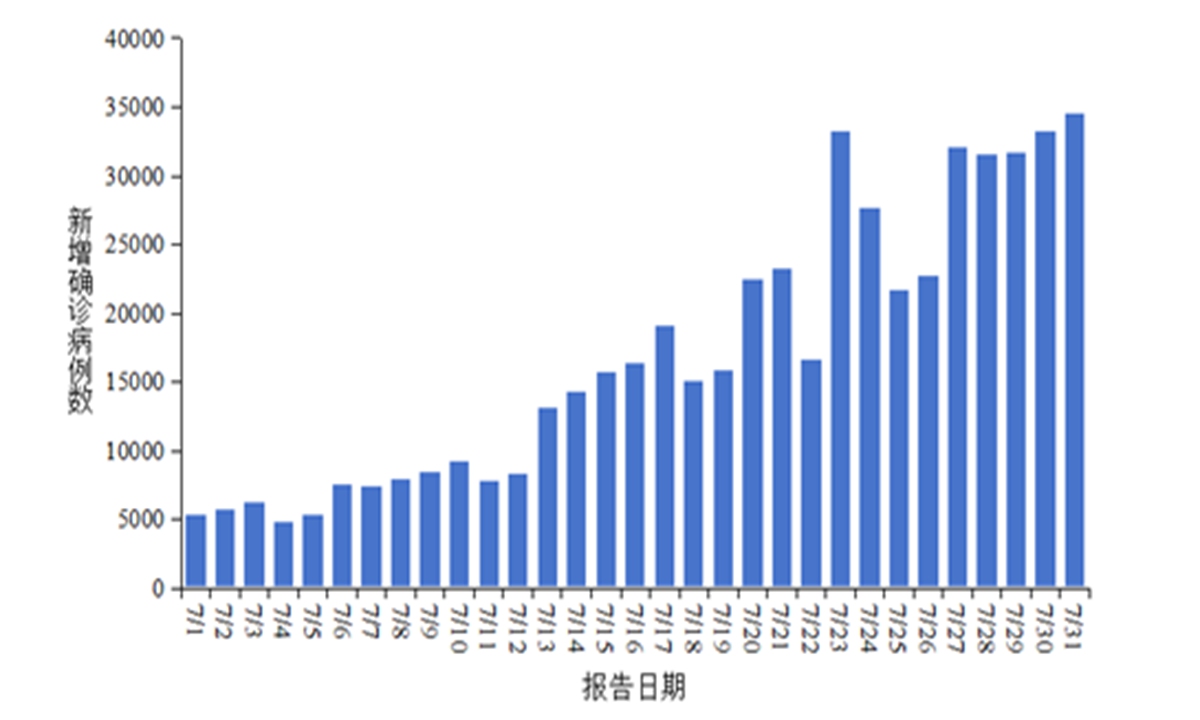
According to sentinel hospital surveillance data, from June 29-July 5 to July 27-August 2, the proportion of influenza-like illness among all outpatient and emergency visits at China's 1,041 COVID-19 and influenza sentinel hospitals edged up with slight fluctuations, standing at 4.3 percent, 4.4 percent, 4.5 percent, 4.4 percent and 4.5 percent, respectively.
During the same period, the COVID-19 positivity rate among patients with influenza-like illness in outpatient and emergency departments rose for consecutive weeks.
Several factors drove the fluctuating rise in COVID-19 cases in July. Population immunity has waned, as more than six months have passed since the last major wave of infections for most people, while continued SARS-CoV-2 mutations have reduced the protection provided by existing antibodies, Li Tongzeng, a respiratory disease medic from Beijing You An Hospital to the Capital Medical University, told the Global Times on Friday.
These factors, combined with increased travel and population mobility during the summer vacation, contributed to the recent small-scale surge. Based on patterns observed in recent years, COVID-19 infections tend to rise every six to eight months as population immunity declines, said Li.
The expert noted that while the virus continues to mutate, there is no evidence that it has become more pathogenic. Clinical data show that most patients develop only mild symptoms, with very few progressing to pneumonia or requiring hospitalization.
The Chinese CDC noted on Thursday that since COVID-19 was reclassified as a Category B infectious disease under Category B management, it has evolved into a prevalent, recurring respiratory infectious disease in China, with one to two epidemic fluctuations occurring nationwide each year.
Li also noted that residual immunity from previous infections also helps reduce disease severity, with most reinfections presenting as mild upper respiratory symptoms that resolve within about a week. The single COVID-related death reported nationwide in July further indicates that the current fatality rate remains very low.
Judging from historical epidemic patterns and current case growth trajectories, national infection figures may begin to decline in late August. Nationwide case numbers are now nearly at their peak, with declines already observed in some regions, said Li.
The Chinese CDC also said on Thursday that surveillance had not detected any variants posing major public health risks, nor had the current wave caused notable disruptions to the healthcare system.
The public is advised to take appropriate protective measures, including wearing masks when necessary, maintaining good personal hygiene, adopting healthy lifestyles and getting vaccinated as recommended.
。 〈사진출처=연합뉴스〉 김윤덕 국토교통부 장관이 "그린벨트에 대해 전향적으로 검토하겠다는 서울시 입장에 환영을 표한다"고 말한 데 대해 서울시가 "용산공원 내 주택공급 방침 철회를 전제로 한 것이었다"고 해명했습니다. 오세훈 서울시장과 김윤덕 국토교통부 장관이 오늘(26일) 서울의 한 식당에서 만나 주택 공급 등의 문제를 협의했습니다. 김 장관은 만남 이후 자신의 SNS를 통해 "결과적으로 합의에 이르지 못했으나, 그린벨트에 대해 전향적으로 검토하겠다는 서울시의 입장에 환영을 표한다"고 말했습니다. 그러자 서울시도 곧바로 입장문을 내고 "서울시가 말한 그린벨트 검토는 정부가 용산공원 내 주택공급 방침을 철회한다는 것을 전제로, 이미 훼손돼 보전가치가 낮은 일부 그린벨트 해제를 검토할 수 있다는 취지"라고 밝혔습니다. 그러면서, 서울시는 "정부가 현실 불가능한 용산공원 주장을 내려놓는다면 탄천물재생센터를 비롯한 대체부지와 훼손된 그린벨트 등 서울의 주택공급 확대를 위한 합리적인 방안을 얼마든지 함께 논의할 준비가 돼 있다"고 설명했습니다. 서울시는 '용산공원 주택공급 불가' 입장을 강조하고 있지만 김 장관은 전혀 다른 생각입니다. 김 장관은 서울시에 "'어떤 경우에도 용산 미군 반환부지 내에 절대 집을 지을 수 없다'는 용산 불가론만 고수해선 안 된다"면서 "장교 숙소 등 이미 훼손된 부지 일부를 활용하는 것과 그에 대한 공론화 절차에 대해서도 열린 마음으로 동참해 달라"고 요구했습니다. 두 사람은 다음 주쯤 다시 만나 용산공원과 서울시가 제시한 탄천물재생센터 부지 등을 놓고 이견을 좁혀나갈 예정입니다.。
Current article:http://sddif.chongtunkuaitaogacuiliamanzu.cfd/news/20260826_8173113.html
Published on:11:09:44